










If you order eco food packaging long enough, you will eventually see a “100% biodegradable” label next to a “home compostable” one on trays made from the same sugarcane fiber. The two claims are not the same promise, and the difference decides whether your containers end up in a compost stream, a recycling bale, or a landfill like everything else.
Here is the plain-language version, written for the buyer who has to sign a purchase order rather than write a white paper.
Compostable: a certified deadline
“Compostable” is the most specific claim of the three, because it is the only one with a clock attached. A compostable food container has to break down into CO2, water and biomass within a defined period, leave no toxic residue, and meet strict limits on heavy metals. Two standard families cover almost all of the trade:
- ASTM D6400 (US) and EN 13432 (EU) — industrial composting. Typical acceptance is around 90% disintegration within 12 weeks at 55-60 °C, alongside a biodegradation rate measured over a longer window.
- AS 5810 and the OK Compost HOME scheme — home composting, which runs far cooler. A material that passes industrial tests routinely fails at home-compost temperatures, which is why the two labels are not interchangeable on retail packaging.
Materials you will actually buy under this label: sugarcane bagasse containers, cornstarch trays and bowls, molded pulp boxes, and PLA/PBAT films in compostable cling wrap.
Industrial versus home compostable: know which bin you are promising
Industrial composting needs a facility, a thermometer and turning. Home composting needs a backyard pile at ambient temperature. The gap matters commercially:
- Food-service chains contracting with municipal waste streams usually want industrial certification, because that is what their hauler actually delivers to.
- Retail and e-commerce brands selling to households increasingly ask for home-compostable claims, because the customer has no compost facility and the label is what prevents a complaint.
- Claiming home-compostable on an industrial-only product is the single most common way brands get challenged by a regulator or a competitor.
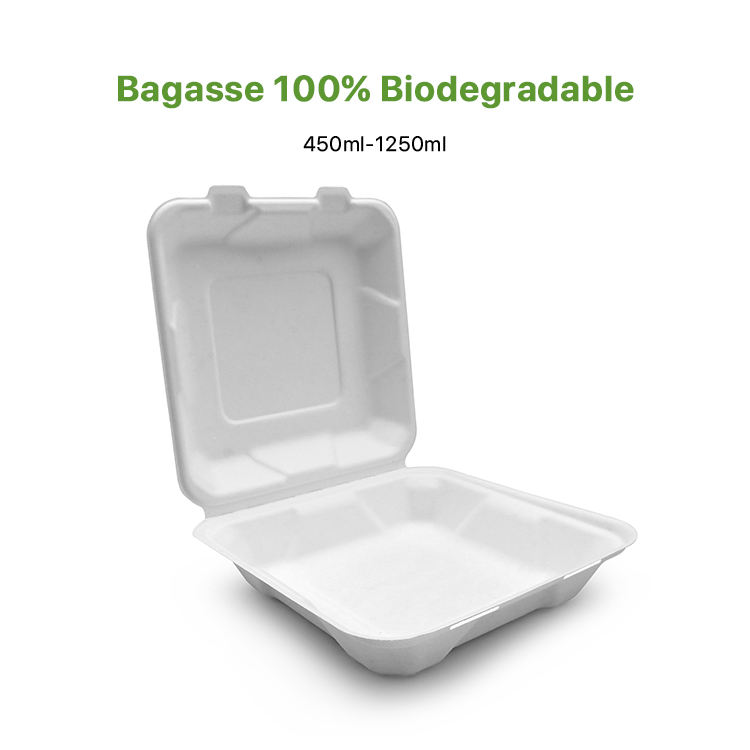
Biodegradable: a promise without a date
“Biodegradable” only says microorganisms can eventually eat the material. It carries no timeframe, no temperature, no disintegration percentage and no residue test. Paper is biodegradable. So is a cotton shirt. In practice, a biodegradable label on a food container is a weaker claim than a compostable one, and it is often made against materials that would take years to break down in a modern landfill, where the environment is dry, cold and short of oxygen.
Treat “biodegradable” as background language, not as an end-of-life plan. If a supplier offers only that word and cannot name a standard, you are buying an adjective.
Recyclable: the claim that depends on someone else’s bin
Recyclability is the least supplier-controlled of the three, because it depends on contamination levels and local infrastructure rather than the resin itself.
- PET (#1) and PP (#5) in clear blister and clamshell packaging are technically recyclable and widely accepted in clean, dry, empty condition. Food-soiled or sauce-glazed trays are usually rejected.
- Molded fiber — bagasse and pulp — behaves like paper in most streams, but wax or PLA coatings and heavy grease load can knock it out.
- PLA looks like PET and feels like PET, and it is a genuine contaminant in a PET bale. Running clear compostable lids alongside clear PET lids in one operation is how both streams get quietly ruined.
- Kraft paperboard in kraft boxes and bags recycles well when it is not PE-lined; PE coating has to be separated at a paper mill.
How to pick between them, by buyer type
| Your situation | Claim that holds up | What to verify |
|---|---|---|
| Restaurant or cloud kitchen with a commercial compost hauler | Industrial compostable | Certificate number, standard, fluorine report |
| Grocery or fresh produce, existing PET tray supply chain | Recyclable, or RPET content | Resin code, rPET percentage, contamination rules |
| Direct-to-consumer kitchenware or meal-prep brand | Home compostable | OK Compost HOME or AS 5810, not D6400 alone |
| Catering, events, stadium or campus contracts | Compostable where organics collection exists | Whether the venue actually runs a stream |
| Anything shipping to a household | Recyclable fiber or home compostable | Bin-side reality of your customer |
The documentation that settles an argument
Before a claim goes on your packaging or your listing, ask the factory for four things: the certification for the exact product and thickness, not the general company range; a test report for total fluorine or a PFAS-free declaration; a statement of what the fiber or resin is actually made of; and the compostable logo license terms if you intend to print a certification mark. A supplier who can produce those four documents in a few days is a supplier whose labels will survive scrutiny.
When the specification is set, the next question is usually cost and sourcing — see our guide to choosing packaging by buyer program, or send us the menu and volumes and we will recommend a material on the contact page.
