










A restaurant that switches to eco packaging usually starts with a catalog: 9×9 clamshell, 24 oz bowl, 3-compartment tray. Then the complaints arrive — soggy burger boxes, dressing-soaked salad lids, sauces that leak through a seam, and rice that steams into a clamshell lid. None of it is a material failure. It is a matching failure.
Start from the dish, not the box
Four properties of the food decide the container, and they are worth writing down per menu item before you price anything:
- Temperature at handover. Food packed above roughly 60 °C in a sealed fiber box generates condensation, and condensation is what turns a crisp coating soft.
- Moisture and sauce load. Wet food in a porous fiber tray looks fine on the shelf and fails at the customer’s table. Grease is the second half of the same problem — oil migrates through untreated paper faster than water.
- Acidity and color. Tomato, citrus and turmeric-heavy sauces stain and, over long holds, attack some coatings.
- Time between pack and eat. A 20-minute delivery and an 8-hour meal-prep fridge hold are different packaging problems wearing the same costume.
The formats, and what each one is actually for
Hinged clamshell
Fastest to pack with one hand, and the cheapest way to present a mixed plate. Best for burgers, sandwiches, grains-and-protein bowls served immediately. Choose bagasse or kraft paper clamshells for hot food. Avoid for anything with loose liquid — the hinge seam is where it escapes.
Square and round bowls with a separate lid
The workhorse for soups, pasta, rice, salads and grain boxes. A separate lid seats deeper and holds better in a bag than a clamshell clasp. Round cornstarch bowls handle hot liquids and reheating cleanly; fiber bowls are lighter and cheaper in bulk. Size in ounces, then check the millilitre equivalent — a 24 oz / 700 ml bowl and a 26 oz / 750 ml bowl are often the same mold family with different lids.
Trays without a lid
Bakery, produce, meat and deli counters where the item is wrapped or sealed separately. Bare trays stack, ship flat and cost the least per piece. Pair a molded pulp tray with a stretch film or a clear blister lid instead of buying a combined box when the food is dry.
Compartment boxes
Two, three, five and six-section formats exist for a reason: separation. They suit meal prep, bento, school and airline catering, snack boards and any plate where a sauce touches a starch. Compartment walls also add rigidity to a thin-gauge tray. The trade-off is packing speed — more sections means more hand time and more dead volume if a portion does not fill.
Deli cups, sauce cups and cutlery
The items that get forgotten in the budget, then bought at retail prices in a panic. Sauce cups in 1-4 oz with a snap or peel lid should be specified alongside the main container, because the container’s lid design may block a cup from fitting inside the box. If your boxes are microwaved, cutlery should be too.
Size language, decoded
| Label you see | What it measures | Watch out for |
|---|---|---|
| 500 / 750 / 1000 ml, 8 oz / 16 oz / 32 oz | Capacity to the fill line, sometimes to the brim | A 32 oz bowl filled to 32 oz will not close |
| 6 / 8 / 9 / 10 inch | Internal or external footprint depending on supplier | A 9-inch plate and a 9×9 box are not the same number |
| 2 / 3 / 5-compartment | Section count, not portion size | Section volumes are usually unequal |
| with lid / without lid | Whether the lid is in the price | Clear PET lids on compostable trays break both streams |
The lid is half the specification
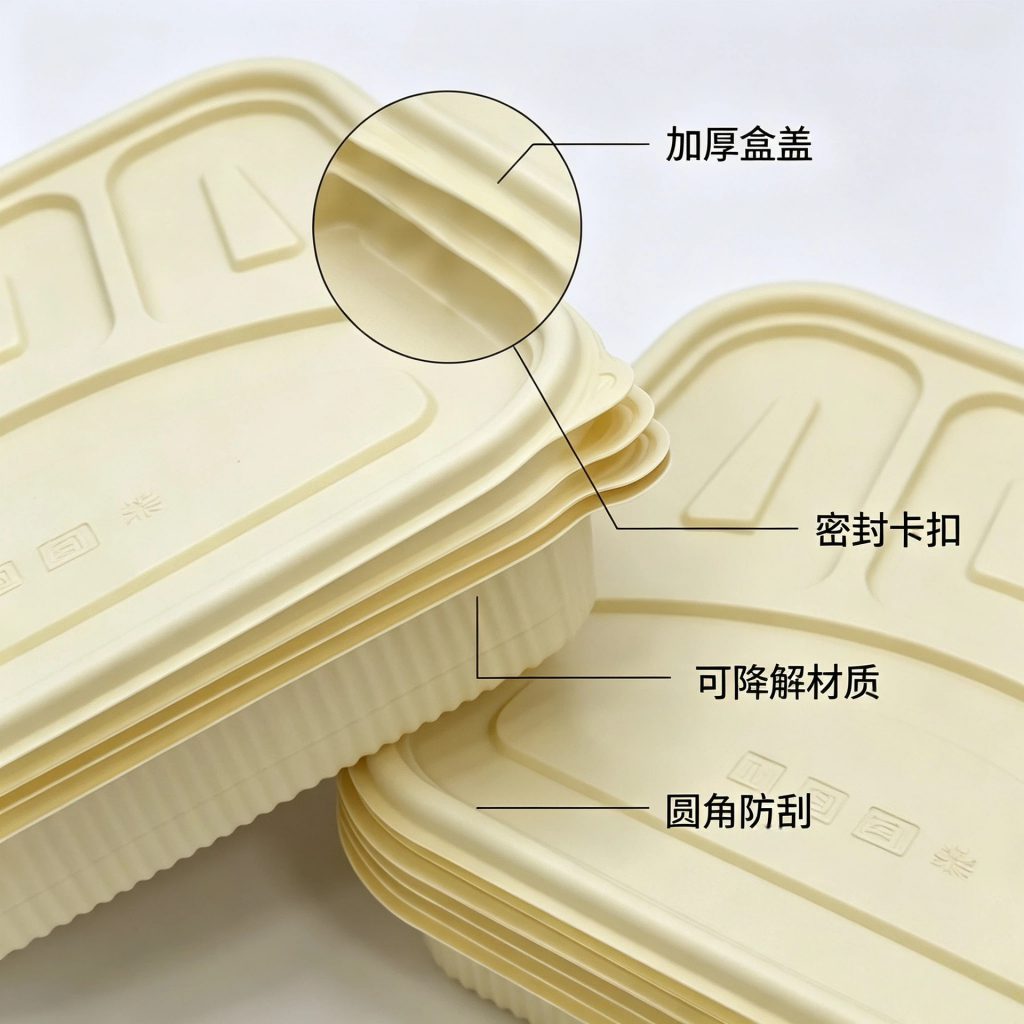
More complaints come from lids than bases. Decide between a vented fiber lid (hot food, steam escapes, coating stays crisp), a clear hinged PET dome (display value, moisture stays in), a snap lid (resealable, best for meal prep), and a peel-seal film (leak-proof, needs a sealer). Then test it loaded: fill the container, close it, hold it at an angle for ten minutes, microwave it for two minutes and press the seam. That twenty-minute test predicts a season of reviews.
Microwave and freezer: check the pairing, not the label
Bagasse, cornstarch and molded fiber are generally microwave-safe for reheating; kraft boxes are safe unless they carry a metalised or PE liner; PET and PP blister formats each have their own heat ceilings, and only PP is genuinely microwave-friendly of the two. Freezer use follows a different rule than microwave use — the concern is brittleness at minus temperatures and moisture at the seams, and fiber loses structural memory when it freezes wet. Ask the supplier to state a temperature range per product, and put it in your own spec sheet, not just their datasheet.
Where the money leaks
- Buying one size “because it covers everything” and paying for dead volume in every bag.
- Mixing clear plastic lids into a compostable line, which forces two suppliers and two disposal stories.
- Ordering lids separately at a later date and finding the mold changed.
- Skipping the grease test on sauced items, then switching materials mid-season at rush prices.
If you send us the menu, the average portion weight and the packing line, we will spec the format list with you — the FAQ covers the common questions, or start at contact.
